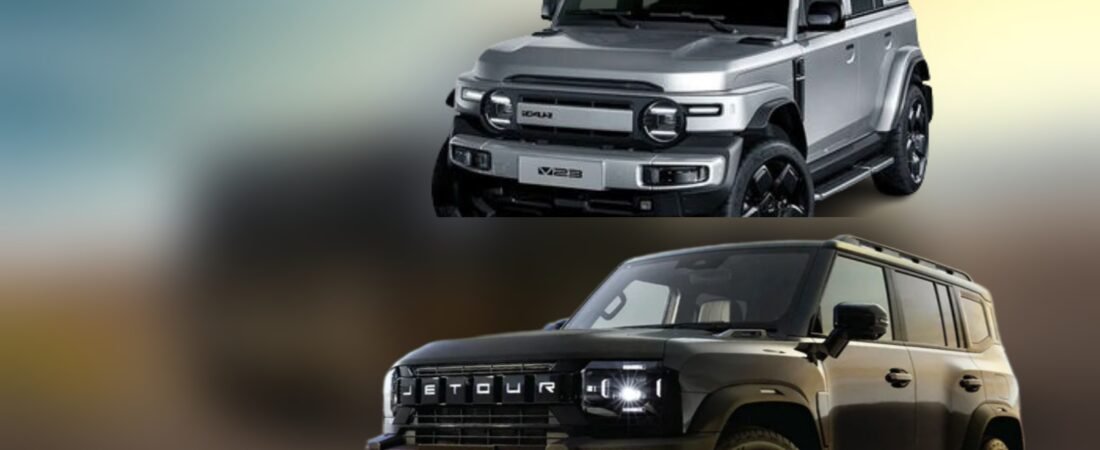
TL;DR: The Jetour T2 (fuel-powered) and iCAR V23 (electric) are two popular boxy SUVs in Malaysia. The T2 offers more space, a panoramic sunroof, and a 70L fuel tank for long trips, while the V23 is compact, eco-friendly, and has lower running costs. This guide compares prices, specs, family features, off-road ability, and running costs to help Malaysian families choose the right boxy SUV.
Jetour T2 vs iCAR V23: Which Boxy SUV Fits Your Family?
Malaysian roads are seeing a surge in boxy SUVs — vehicles that blend retro styling with modern practicality. Two contenders leading this trend are the Jetour T2, a fuel-powered rugged SUV, and the iCAR V23, a compact electric SUV. Both appeal to families seeking space, safety, and versatility, but they cater to different priorities. This detailed buying guide breaks down every aspect that matters to Malaysian buyers: price, specifications, family suitability, off-road capability, running costs, and real-world usability. By the end, you’ll know whether the Jetour T2’s spaciousness and long-range fuel efficiency or the iCAR V23’s electric simplicity and lower ownership cost aligns better with your family’s lifestyle.
Jetour T2 vs iCAR V23: Key Differences at a Glance
Before diving into details, here’s a quick comparison of the core specifications:
| Feature | Jetour T2 | iCAR V23 |
|---|---|---|
| Powertrain | 2.0L Turbo Petrol Engine | Dual Electric Motor |
| Power Output | 190 hp, 340 Nm | 200 hp, 340 Nm (combined) |
| Transmission | 6-Speed Automatic | Single-Speed Reduction Gear |
| Drive Type | XWD Intelligent Four-Wheel-Drive | Rear-Wheel Drive (Standard) / All-Wheel Drive (Optional) |
| Seating Capacity | 5 Seats | 4 Seats |
| Dimensions (LxWxH) | 4,785 mm x 1,900 mm x 1,780 mm | 4,220 mm x 1,820 mm x 1,640 mm |
| Wheelbase | 2,800 mm | 2,610 mm |
| Ground Clearance | 220 mm | 180 mm |
| Wading Depth | 700 mm | 300 mm |
| Fuel Tank / Battery | 70L Petrol Tank | 52.5 kWh Lithium-Ion Battery |
| WLTP Range | N/A | ~400 km (claimed) |
| Fuel Consumption (Combined) | 8-9L/100km (real-world) | N/A |
| Electricity Consumption | N/A | ~16 kWh/100km |
| Price (Malaysia) | RM156,800 (on-the-road) | RM132,780 (on-the-road) |
| Road Tax (Annual) | RM439 | RM180 |
| Warranty | 3 Years / 100,000 km | 5 Years / 150,000 km (battery 8 years) |
| Key Features | Panoramic Sunroof, Dual-Zone AC, Rear Air Vents, 12-Speaker Sony Sound, Ventilated Front Seats, L2 Driving Assistance | Touchscreen Infotainment, Regenerative Braking, Eco Mode, Standard Safety Suite |
Data sourced from manufacturer specifications and Malaysian automotive reviews (2026).
Is It Suitable for Family Use? Space, Comfort, and Practicality
Jetour T2: Built for Family Adventures
The Jetour T2’s square design maximizes interior volume. With a length of 4,785 mm and a wheelbase of 2,800 mm, it offers generous legroom and headroom for all five occupants. The rear seat backrest angle is optimized for long journeys, reducing fatigue during trips to hometowns or weekend getaways.
Comfort features are plentiful: dual-zone automatic air conditioning ensures the driver and front passenger can set their preferred temperatures, while rear air vents keep backseat passengers cool — essential in Malaysia’s humid climate. A panoramic sunroof floods the cabin with natural light, and the 12-speaker Sony sound system delivers concert-quality audio for family sing-alongs. Ventilated front seats are a standout feature, providing airflow to keep drivers cool during stop-and-go traffic.
Safety is a strong suit: the T2 earned an ASEAN NCAP Five-Star rating, comes with six airbags, and includes Level 2 intelligent driving assistance (adaptive cruise control, lane-keeping assist, blind-spot monitoring, and automatic emergency braking). These features provide peace of mind when transporting children or elderly parents.
iCAR V23: Compact Efficiency for Urban Families
The iCAR V23, at 4,220 mm long, is more compact, making it easier to maneuver in tight city parking spots and navigate narrow kampung roads. Its 4-seat layout (two front, two rear) means it’s best suited for smaller families or those who rarely carry more than four passengers. Rear legroom is adequate for children but may feel snug for adults on longer trips.
Despite its size, the V23 doesn’t skimp on comfort. It features automatic climate control (single-zone), a touchscreen infotainment system with smartphone integration, and regenerative braking that adds a touch of engagement to city driving. Standard safety equipment includes multiple airbags, ABS with EBD, electronic stability control, and a rearview camera. However, it lacks advanced driver-assistance systems (ADAS) like adaptive cruise control or lane-keeping assist in its base Malaysian specification.
For families prioritizing zero emissions and lower running costs, the V23’s electric powertrain is appealing. Charging at home overnight can cover daily commutes, and public DC fast chargers can top up the battery to 80% in about 40 minutes.
Can It Go Off-Road? Weekend Getaway Capability
Jetour T2: Light Off-Road Ready
The Jetour T2 is designed for “light off-road” adventures — think gravel roads, muddy trails, and sandy beaches — not extreme rock crawling. Its 220 mm ground clearance and 700 mm wading depth allow it to tackle flooded roads during monsoon season with confidence. The XWD intelligent four-wheel-drive system automatically distributes torque between front and rear axles, and drivers can select from seven modes (including Snow, Mud, and Sand) to optimize traction.
Approach, breakover, and departure angles are favorable (30°, 22°, and 30° respectively), enabling the T2 to navigate steep inclines and declines without scraping the bumpers. All-terrain tires come standard, providing grip on loose surfaces. For families who enjoy camping at sites like Sungai Lembing or exploring the East Coast’s beaches, the T2 offers genuine capability without needing extensive modifications.
iCAR V23: Urban-Oriented, Limited Off-Road
The iCAR V23 is primarily an urban vehicle. Its ground clearance of 180 mm is modest, and it lacks a dedicated four-wheel-drive system (though an optional AWD variant exists in other markets, not currently sold in Malaysia). Approach and departure angles are around 20°, limiting its ability to tackle steep inclines or deep ruts. While it can handle light gravel or well-maintained dirt roads, it’s not suited for muddy trails, river crossings, or sandy terrains.
Electric vehicles also face challenges with water ingress; the V23’s battery is sealed to IP67 standards, allowing temporary submersion up to 1 meter, but deep wading is discouraged. For families whose idea of adventure is a trip to the zoo or a picnic at a lakeside park, the V23’s capabilities are sufficient. However, those seeking genuine off-road versatility will find the T2 more capable.
Fuel and Range: Jams, Long Drives, and Running Costs
Jetour T2: Fuel Efficiency in a Boxy Frame
As a pure petrol vehicle, the Jetour T2 eliminates range anxiety — as long as there’s a petrol station nearby, you can refuel in minutes. Its 70L fuel tank provides a theoretical range of 750–880 km based on the official 7.9L/100km figure. Real-world combined consumption in Malaysian conditions (city traffic, highway cruising, air conditioning use) averages 8–9L/100km, translating to a practical range of 600–700 km per tank.
For a long-distance trip from Selangor to Kelantan (approximately 400–500 km), one refuel stop is sufficient. Fuel costs at current Malaysian petrol prices (RM2.05/liter for RON95) amount to roughly RM16.40–RM18.45 per 100 km. While the T2’s boxy shape increases aerodynamic drag, its fuel consumption is respectable for a vehicle weighing nearly 1.9 tonnes and measuring over 2 metres wide. Regular maintenance (oil changes, servicing) follows the standard schedule for turbocharged petrol engines.
iCAR V23: Electricity Costs and Charging Realities
The iCAR V23’s 52.5 kWh battery offers a claimed WLTP range of 400 km. Real-world range in Malaysian conditions — considering frequent air conditioning use, tropical temperatures affecting battery efficiency, and varied terrain — typically sits between 280–320 km per full charge. This is adequate for daily commutes and weekend trips within a state but requires planning for longer interstate journeys.
Charging costs are significantly lower than fuel. Based on Malaysia’s average electricity tariff (RM0.45/kWh for residential), a full charge costs about RM23.60. At an estimated 16 kWh/100km consumption, the cost per 100 km is roughly RM3.75 — less than a quarter of the T2’s fuel cost. However, access to reliable charging infrastructure remains a consideration. Home charging (using a 7 kW wallbox) takes approximately 7.5 hours for a full charge, while public DC fast chargers (50 kW) can reach 80% in 40 minutes. Families living in landed properties can install home chargers easily; condo dwellers may rely on building-provided facilities or public networks.
Total Cost of Ownership: Beyond the Sticker Price
When comparing total ownership costs over five years, the V23’s lower energy costs, reduced road tax (RM180/year vs. RM439/year), and potentially lower maintenance (no oil changes, fewer moving parts) can offset its higher upfront price difference? Actually, the T2 is RM24,020 more expensive than the V23. Let’s break it down:
- Fuel/Electricity: Assuming 15,000 km/year, the T2 spends ~RM2,460–RM2,770/year on fuel (RM16.40–18.45/100km), while the V23 spends ~RM560/year on electricity (RM3.75/100km). Over five years, fuel costs for the T2 total RM12,300–RM13,850, versus RM2,800 for the V23 — a saving of RM9,500–RM11,050 for the electric.
- Road Tax: T2 pays RM2,195 over five years; V23 pays RM900 — a saving of RM1,295.
- Maintenance: Estimated savings for the V23 (no oil changes, less brake wear due to regen) could be RM1,000–RM2,000 over five years.
- Depreciation: Both vehicles will depreciate, but electric vehicles may hold value better as demand grows; however, battery replacement costs after warranty (8 years) are a long-term consideration.
Overall, the V23’s lower running costs can save a family approximately RM12,000–RM15,000 over five years, narrowing the upfront price gap significantly. For families with access to reliable home charging and predominantly urban usage, the V23 presents a compelling economic case. Conversely, those who frequently travel long distances, value quick refueling, or need greater interior space may find the T2’s strengths worth the higher ongoing costs.
FAQ: Common Questions from Malaysian Buyers
Q: Is the Jetour T2 available with a hybrid or electric option?
A: As of 2026, the Jetour T2 sold in Malaysia is exclusively powered by the 2.0L turbo petrol engine. Jetour offers hybrid and electric variants in other markets, but these are not yet locally assembled or imported for the Malaysian market.
Q: Does the iCAR V23 qualify for any government EV incentives in Malaysia?
A: Yes, the iCAR V23 is eligible for the Malaysian government’s EV incentive package, which includes exemption from import duty, excise duty, and sales tax. This incentive is already reflected in its on-the-road price of RM132,780. Additionally, EV owners enjoy reduced road tax (as shown) and may be eligible for corporate tax benefits if purchased through a company.
Q: Can I install a home charging station for the iCAR V23 if I live in a condo or apartment?
A: It depends on your building’s management and electrical capacity. Many newer condos in Kuala Lumpur, Penang, and Johor Bahru are installing EV-ready charging bays in communal parking areas. You’ll need to obtain approval from the management corporation and potentially share installation costs. Some developers offer pre-wired parking spaces for easier retrofitting. Landed property owners face fewer restrictions and can typically install a private wallbox without issue.
Q: How does the Jetour T2’s L2 driving assistance compare to systems in competitors like the Toyota RAV4 or Honda CR-V?
A: The Jetour T2’s L2 suite includes adaptive cruise control, lane-keeping assist, blind-spot monitoring, and automatic emergency braking — features comparable to mid-tier systems in the RAV4 and CR-V. However, it may lack more advanced functions like highway driving assist or traffic jam assist found in higher-spec Japanese or European rivals. For daily Malaysian driving conditions, the T2’s system provides meaningful fatigue reduction on long highways.
Q: Which vehicle has better resale value in Malaysia?
A: Historical data is limited for both models as they are relatively new entrants. However, electric vehicles globally are showing strong residual values due to growing demand and lower operating costs. The iCAR V23’s eligibility for EV incentives and lower running costs may support better resale demand in the secondary market. The Jetour T2’s rugged appeal and spaciousness could also attract buyers seeking used family SUVs. Ultimately, factors like mileage, condition, and maintenance history will dominate resale outcomes for either vehicle.
Conclusion: Matching the Vehicle to Your Family’s Lifestyle
Choosing between the Jetour T2 and iCAR V23 boils down to how your family prioritizes space, versatility, running costs, and environmental impact.
Choose the Jetour T2 if you:
– Regularly carry five passengers or need generous cargo space for strollers, luggage, or sports equipment
– Frequently embark on long-distance trips across Peninsular Malaysia and value the convenience of quick refueling
– Enjoy light off-road adventures, such as beach camping, jungle trail drives, or monsoon-season road trips
– Appreciate premium comfort features like ventilated seats, a panoramic sunroof, and a high-end sound system
– Prefer the familiarity of a petrol engine and are comfortable with higher fuel costs in exchange for lower upfront complexity
Choose the iCAR V23 if you:
– Have a smaller family (typically four or fewer passengers) and primarily undertake urban or suburban commutes
– Have reliable access to home charging or convenient public charging infrastructure near your home/workplace
– Prioritize minimizing running costs and reducing your carbon footprint
– Value the instant torque and quiet operation of an electric drivetrain for city driving
– Are attracted to lower road tax, potential EV incentives, and simpler maintenance
Both vehicles represent the evolving tastes of Malaysian car buyers who seek practicality without sacrificing style. The Jetour T2 excels as a versatile family hauler ready for both school runs and weekend getaways, while the iCAR V23 offers an efficient, eco-friendly alternative for urban-focused households. By assessing your family’s typical usage patterns, budget for running costs, and desired features, you can confidently select the boxy SUV that will serve your adventures for years to come.
More from ZFRBuild
- School Holiday Bucket List: 10 Things to Do with Kids in
- Holiday link! Late August to mid-September: Malaysia’s busiest month
Related Article
- Top Air Purifiers for KL Apartments: Haze-Season Picks — Haze-season ready: the best air purifiers for KL apartments compared, with RM prices and filter costs.
- How to use CCTV to enhance home safety: AI CCTV monitoring — Turn your cameras from passive recorders into an active home security system with AI detection, smart alerts and easy setup.
- Malaysia’s Top 10 High-Value CCTV Recommendations for 2026 — The best-value CCTV cameras in Malaysia for 2026 — TP-Link Tapo C545D, EZVIZ H80X DUAL, Xiaomi C301 and seven more picks, with prices and buying tips.
- Best Washing Machines with Built-in Dryer (Malaysia 2026) — Compare the best washing machines with built-in dryer for small Malaysian homes — sizes, RM prices, energy ratings and top picks for 2026.
- ReactOS 0.4.16 Released with Graphical Installer — The open-source Windows-compatible OS finally gets a graphical installer, a unified ISO, and a new ATA driver.
- How long does food take to digest? Bedtime eating explained — How long does food take to digest — and should you eat before bed? Digestion timings, reflux risks and gentle snack ideas for better sleep.