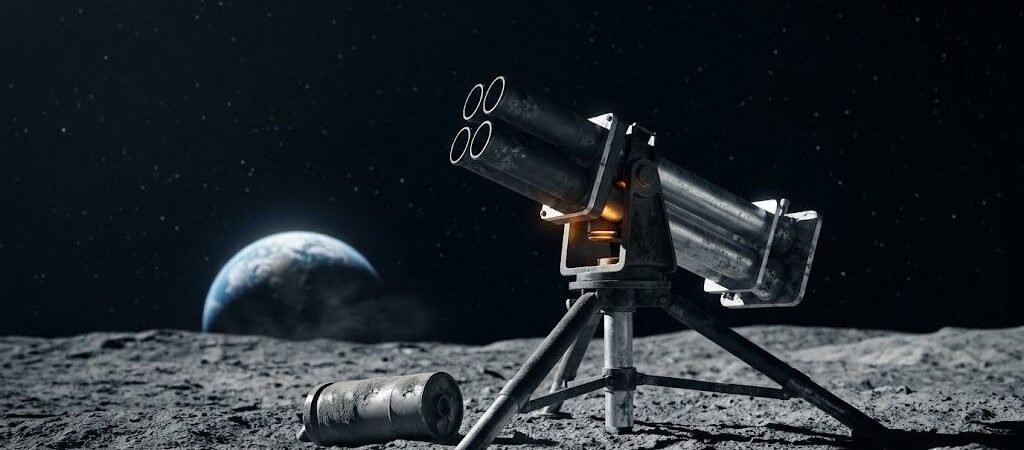
Why did some Apollo missions carry a grenade launcher?
TL;DR — Apollo 14 and Apollo 16 carried a four-barrel grenade launcher to the Moon as part of the Active Seismic Experiment: a mortar that lobbed small explosive charges 150 to 1,500 metres away so seismometers could time the shockwaves and measure what lay beneath the surface. It was geology by detonation, not a weapon. Apollo 14’s four grenades were never fired and are still sitting at Fra Mauro; Apollo 16 fired three of four before a failed tilt sensor grounded the last one.
The short answer: a mortar for measuring the Moon
The device’s official name was the mortar package, and its business end was the Grenade Launch Assembly. It sat on the lunar surface as one component of the Apollo Lunar Surface Experiments Package (ALSEP), the nuclear-powered instrument station each landing crew left behind.
Its job was to answer a question that photographs and rock samples could not: how thick is the rubble? The lunar surface is covered in regolith — a blanket of dust, grit and impact debris built up over billions of years. Engineers planning bases, miners dreaming of oxygen from ilmenite, and geologists trying to read the Moon’s history all needed to know how deep that blanket went before you hit competent rock. You cannot see through it from orbit, and a core tube only samples one narrow column.
So the experiment’s designers borrowed a technique that had been standard in terrestrial oil and mineral exploration since the 1920s: seismic refraction. You make a bang at a known distance, you time how long the shockwave takes to reach a sensor, and from the change in speed you deduce what the wave travelled through. Fast arrival means dense rock. Slow arrival means loose rubble. Where the velocity jumps, there is a boundary.
The Apollo grenade launcher existed to place those bangs at distances no astronaut could walk to and back within a spacewalk.
It is worth stating plainly that nothing about this hardware was offensive. The charges had thin fibreglass casings, high-explosive fills between 45 and 454 grams, and no fragmentation sleeve. Their only lethal use was to the experiment itself if a crew had been standing nearby when one went off, which is precisely why every firing was commanded from Earth after the astronauts had gone home.
Which missions carried it — and which never fired
Two missions flew the mortar package, Apollo 14 in February 1971 and Apollo 16 in April 1972. The third mission with a comparable experiment, Apollo 17 in December 1972, used a different approach entirely: eight explosive packages that the crew armed and laid out by hand along their rover traverses, at ranges out to 2.7 kilometres, detonated later by radio command between 16 and 18 December 1972. No launcher was needed because the rover could carry the charges where they had to go.
| Apollo 14 (Fra Mauro) | Apollo 16 (Descartes) | Apollo 17 (Taurus-Littrow) | |
|---|---|---|---|
| Experiment | Active Seismic Experiment | Active Seismic Experiment | Lunar Seismic Profiling Experiment |
| Charges | 4 grenades + 21 thumper shots | 4 grenades + 21 thumper shots | 8 hand-placed explosive packages |
| Fired | 0 grenades, 13 thumper shots | 3 grenades, 19 thumper shots | 8 of 8 |
| Longest shot | none attempted | 900 m | 2,700 m |
| Outcome | 104 m/s regolith over 299 m/s breccia | 114 m/s over 250 m/s, boundary at 12.2 m depth | Travel times to 2.7 km; 850 m/s vs 280 m/s discrepancy |
Apollo 14’s failure to fire is the strangest part of the story. The mortar package was deployed off-nominal — a crater sat exactly where the launcher was supposed to stand, so it ended up closer to the other ALSEP instruments than the designers intended. Firing four grenades from that position risked throwing dust and debris across the central station and the laser retroreflector. Post-flight tests suggested the central station would at minimum have suffered thermal degradation. NASA skipped the shots, then considered firing them years later near the end of the station’s life. By then the uplink capability was gone and the arming capacitors would no longer charge. The four grenades are still there.
Apollo 16 got further. Three grenades left their tubes in the order 900 m, 150 m, 300 m — a sequence chosen deliberately, because firing the short shots first would have made the launcher’s footing less stable. Then the pitch-angle sensor on the mortar package went off-scale, leaving its aim uncertain, and the 1,500-metre grenade was never attempted. Even the successful shots registered: the most powerful detonation tilted the passive seismometer nearby by about three arcseconds.
How the Apollo grenade launcher worked
The hardware was a masterclass in doing a lot with very little, under constraints that would make a Malaysian process engineer wince — no maintenance access, no second attempt, and a 2.6-second radio delay each way.
The launcher itself was a fibreglass launch-tube assembly: four tubes, each with a 3-inch cross-section, two of them 9 inches long and two 6.5 inches long. They were fixed at a 45-degree launch angle, which maximises range for a given muzzle velocity in a vacuum as surely as it does in air. The whole assembly weighed 10.88 pounds including grenades; the complete mortar package came to 14.95 pounds. Apollo 16 added a subpallet for footing stability and lengthened the cable to the central station from 3 metres to 15.2 metres to keep the launcher away from the other instruments.
Inside a single grenade
Each grenade was a small rocket, not a thrown bomb. A thin fibreglass body, 2.7 inches square and 4 to 6 inches long, contained a solid rocket motor, a safe-slide plate, the high-explosive charge, a detonating cartridge, an omnidirectional impact switch, a thermal battery, and a 30 MHz transmitter. Larger grenades got bigger motors and more propellant, which is how one design covered a tenfold range span.
| Grenade | Target range | Mass | High explosive | Mean velocity | Lunar flight time |
|---|---|---|---|---|---|
| 1 | 1,500 m | 1,236 g | 454 g | 49 m/s | 44 s |
| 2 | 900 m | 1,020 g | 272 g | 40 m/s | 32 s |
| 3 | 300 m | 810 g | 136 g | 23 m/s | 19 s |
| 4 | 150 m | 719 g | 45 g | 16 m/s | 13 s |
Two details deserve admiration. First, the range line: a thin stranded stainless-steel cable wound around the outside of each tube and attached to the grenade. It performed three jobs. It carried two fine copper breakwires spaced so the first snapped 16 inches after launch and the second exactly 25 feet later, bracketing the grenade’s velocity from the timing of the two breaks. It then trailed behind the grenade in flight and served as a half-wave end-fed antenna for the 30 MHz transmitter, so the ground station could hear the moment of impact and derive range independently. One piece of wire, three measurements.
Second, the grenade was a one-shot system in the strictest sense. Leaving the tube, it spring-ejected a safe slide, which let a microswitch close and dump a capacitor through a thermoelectric match, which lit a thermal battery. The thermal battery then powered the transmitter and charged the detonator capacitors. There was no battery to go flat because there was no battery until the moment of launch. Detonation was triggered by an omnidirectional impact switch on touchdown.
The command sequence from Earth
Firing was a two-step, per-grenade affair. An ARM GRENADES command applied 24 volts to charge the firing capacitors in the mortar box and inside each grenade. Then a separate FIRE GRENADE command for a specific grenade discharged its capacitor into a single-bridgewire initiator, igniting the propellant. Propellant burned out before the grenade cleared the tube, so the tube only ever saw the launch impulse.
Because a stuck grenade would have ended the experiment, the design carried a redundant sequential firing circuit: microswitches in tubes 2, 3 and 4 closed as each grenade left, arming the next one in the chain, and each step still required its own arm and fire command from Earth. Thermal control was equally paranoid — multilayer aluminised-Mylar insulation, heaters, temperature sensors, low-pass filters on the firing circuits, resistors across every capacitor and initiator to bleed static, and a cover that doubled as a radio-frequency-interference shield until the first grenade punched through it.
What the grenades actually measured
The point of all that machinery was a travel-time curve: distance on one axis, arrival time on the other. Three geophones sat along a line in the firing direction, and the shockwave from each detonation reached them at different times. The slope of that line is the seismic velocity of the material the wave passed through.
At Apollo 14, the thumper shots gave a regolith compressional velocity of 104 m/s over a layer at 299 m/s, and the ascent stage of the lunar module — an unplanned but enormous seismic source — implied a deeper horizon at 386 m/s or faster. At Apollo 16, the surface layer came in at 114 m/s over 250 m/s material, with the refracting boundary at 12.2 metres depth. That last number settled a live argument. Estimates of regolith thickness at the Descartes site from crater-counting had ranged from about 7 metres to about 22 metres; the seismic data supported the shallow end.
Those numbers look trivial. They were not. Velocity tells you porosity, fracturing and consolidation — the difference between ground you can trench and ground you must drill and blast for a foundation. Every subsequent model of the lunar surface, including the ones used to design lander footpads and to estimate how much dust a rocket plume will kick up, descends from measurements like these.
The experiment also produced a genuine puzzle. Apollo 17’s array recorded arrivals that implied velocities around 850 m/s for waves crossing the array itself, but only about 280 m/s for waves arriving from the distant explosive packages. That inconsistency, debated in the literature for years, is the sort of thing that only shows up when you have both near-field and far-field sources — which is exactly what a grenade launcher buys you.
Why the astronauts never pulled the trigger
The grenades were never fired while a crew was on the surface, and the physics explains why better than any safety memo.
Lunar gravity is about one-sixth of Earth’s, and range scales inversely with gravity, so an identical launch throws a projectile roughly six times further. Remove the atmosphere and there is no drag to slow the fragments either. A charge that would scatter shrapnel across 30 metres on Earth covers a couple of hundred metres on the Moon, and the astronaut in a pressure suit has no cover, no helmet rated for it, and no way to run. The mortar package was therefore armed only after the lunar module had departed, by commands sent from Mission Control.
Dust was the second reason. The Moon has no weather to wash it away, and the ALSEP instruments were exquisitely sensitive — a passive seismometer that could feel a crewman walking past the central station, as Apollo 14’s operators discovered when the commander’s footsteps contaminated their quiet periods. Throwing a few kilograms of grit across the instrument farm to gain one data point was a trade the experimenters only accepted when the alternative was no data at all, and Apollo 14’s launcher was too close for the trade to be worth it.
Third, and least glamorous: the launcher was a single-shot device with no way to re-aim it. Apollo 16’s tilt sensor failed partway through the sequence, and rather than fire blind with a 1.5-kilogram grenade at an unknown angle, the team stopped. Three of four. That is what disciplined engineering looks like when you cannot walk outside to fix it.
The thumper: the hand-held cousin
The mortar was only half of the Active Seismic Experiment. The other half was a device the astronaut carried: the thumper, a 4.64-pound, 44.5-inch tube holding 21 small initiators that fired one at a time into the ground on command, like a bolt-action rifle for geology.
The geology equivalent of tapping a wall to find the studs. The crew laid a geophone line, then walked it firing the thumper at 15-foot intervals, giving a dense stack of short-range travel times that anchored the interpretation of the long-range grenade shots. Apollo 14’s crew got 13 shots off in 28 minutes under a glove-unfriendly mechanism that jammed when lunar soil worked into the arm/fire switch; Apollo 16 managed 19 in 14 minutes after the timeline was tightened to 10 seconds of silence before and after each shot instead of 20.
The thumper explains the experiment’s design philosophy. Short shots, hand-placed and numerous, give resolution near the surface; long shots, launched and few, give depth. Neither works alone. You fire both, overlay the travel-time curves, and read the structure where they meet.
What went wrong, and why it is instructive
Three failures in this programme are worth studying, because each is a textbook case that recurs in terrestrial engineering every week.
The first was Apollo 14’s site. The launcher’s optimum position had a crater in it, so it was deployed elsewhere — a decision made on the ground, under time pressure, that invalidated the experiment’s dust assumptions. The lesson: siting constraints discovered late rarely stay contained.
The second was Apollo 16’s stakes. Four were meant to hold the launcher down; the release pin on the fourth jammed, and the crew could not pull it with a pressure-suit glove even though they reckoned tweezers would have done it. Three stakes were adequate on test. The launcher may have shifted after the third shot. The lesson: accessibility during assembly is part of the design, not an afterthought — the same reason Malaysian fabrication shops cut service clearances into fixtures that nobody will ever open twice.
The third was the tilt sensor. It drifted off-scale during the firing sequence and took the last grenade with it, because without a reliable aim there is no reliable range, and without range the travel time means nothing. The lesson: a measurement you cannot trust is worse than no measurement, especially when the corrective action is irreversible.
Why this still matters in 2026
Lunar seismology did not die with Apollo. NASA’s Farside Seismic Suite, built around a flight spare of the InSight Mars seismometer, is being prepared for a landing in Schrödinger Basin on the lunar far side, with two sensors intended to operate for months through the lunar night. It is a passive instrument — it listens rather than detonates — but it inherits the same scientific question the grenade launcher was built to answer: what is the Moon made of, layer by layer, and how thick is each layer?
The active approach has not been abandoned either. Any future lunar base needs ground truth about bearing capacity, diggability and seismic hazard, and the cheapest way to get it is still to make a controlled bang and time the echo. Commercial landers now carry payload mass budgets that Apollo’s experimenters would have found generous.
There is also a quieter legacy: the grenade launcher is a reminder that space hardware is not magic. It is four tubes, a thermal battery, a piece of wire that doubles as an antenna, and a great deal of fault tolerance bolted around components that cannot be repaired. The reason it worked at all is that every subsystem assumed the others would fail.
What Malaysian engineers can take from it
Seismic refraction is not an exotic technique here. It is routine work on Malaysian ground: site investigation for foundations and cut slopes, cavity detection in the limestone karst that underlies much of Perak and the Kinta Valley, rippability studies before excavation, and the deeper reflection surveys offshore in the Sarawak and Terengganu basins. The Apollo version is a stripped-down, weight-limited, remotely operated variant of the same method — and the constraints are familiar to anyone who has built equipment for a place where nobody can reach it.
The transferable lessons are unglamorous and specific. Design the command interface as a state machine with an explicit arm step, so an accidental fire command cannot do anything. Instrument the aim, not just the trigger, and treat a lost attitude reference as a hard stop. Build redundancy that is sequential rather than parallel when the failure mode is a stuck component. Budget astronaut — or technician — time in minutes, not hours, and remember that a glove is not a hand. And accept that a failed experiment that returns honest data beats a heroic improvisation that destroys the instrument farm.
For developers, there is an analogy that holds up well. The mortar was a remote procedure call with no retry, no timeout recovery, a 2.6-second round trip, and irreversible side effects. Everything built around it — capacitor charging as a two-phase commit, per-grenade commands as idempotency keys, the sequential circuit as a fallback path, the 30 MHz beacon as an acknowledgement — exists because the designers could not assume the network was reliable or the receiver was listening. Systems that must act once, correctly, in an environment where failure is permanent, end up looking like this.
FAQ
Were the Apollo grenades real fragmentation grenades?
No. They were thin-fibreglass-cased rocket-assisted charges with high-explosive fills of 45 to 454 grams and no fragmentation sleeve. Their purpose was to generate a seismic impulse of known size at a known distance, not to injure anyone. Nothing about the design was weaponised, and none was ever fired while astronauts were on the surface.
How many Apollo missions carried a grenade launcher?
Two: Apollo 14 and Apollo 16, both as part of the Active Seismic Experiment. Apollo 17 carried explosive packages instead, eight of them, hand-placed by the crew along their rover traverses out to 2.7 kilometres.
Did the grenades ever explode on the Moon?
Yes, three of them. Apollo 16 fired charges at 900, 150 and 300 metres after the crew had left; the fourth, intended for 1,500 metres, was never launched because the launcher’s pitch-angle sensor failed. Apollo 14’s four grenades were never fired at all and remain at Fra Mauro.
Why were the grenades fired from Earth instead of by the astronauts?
Because a projectile thrown in one-sixth gravity with no atmospheric drag travels roughly six times further than it would on Earth, and its fragments would too. Firing while a crew was within a few hundred metres would have been indefensible, and the dust would have contaminated the other experiments. Remote firing after departure solved both problems at once.
How far could the launcher throw a grenade?
The design covered 150 to 1,500 metres, with the largest grenade — 1,236 grams, 454 grams of high explosive — leaving the tube at about 49 m/s and taking 44 seconds to reach the 1,500-metre target. The longest shot actually achieved was 900 metres, at Apollo 16.
Conclusion
Some Apollo missions carried a grenade launcher because the Moon hides its structure under a blanket of rubble, and the only way to see through that blanket from the surface is to make a bang and listen. Four tubes at 45 degrees, four rocket-assisted charges, three geophones on a line, and a command sequence that assumed everything would eventually fail.
The results were modest numbers — 114 metres per second of regolith over 250 metres per second of breccia, a boundary at 12.2 metres — and they outlived the hardware that produced them. Apollo 14’s four grenades are still lying at Fra Mauro, unfired, patiently waiting for an order that will never come. Half a century later, the technique they were built for is being revived for the next round of lunar exploration, because a controlled explosion is still the cheapest way to ask the ground what it is made of.